My kennel is on Facebook. Do I still need a website?
Facebook is great at bringing people in. What will they find when they type your kennel’s name into Google? Four situations where a website earns its place, and when a Facebook page is all you need.
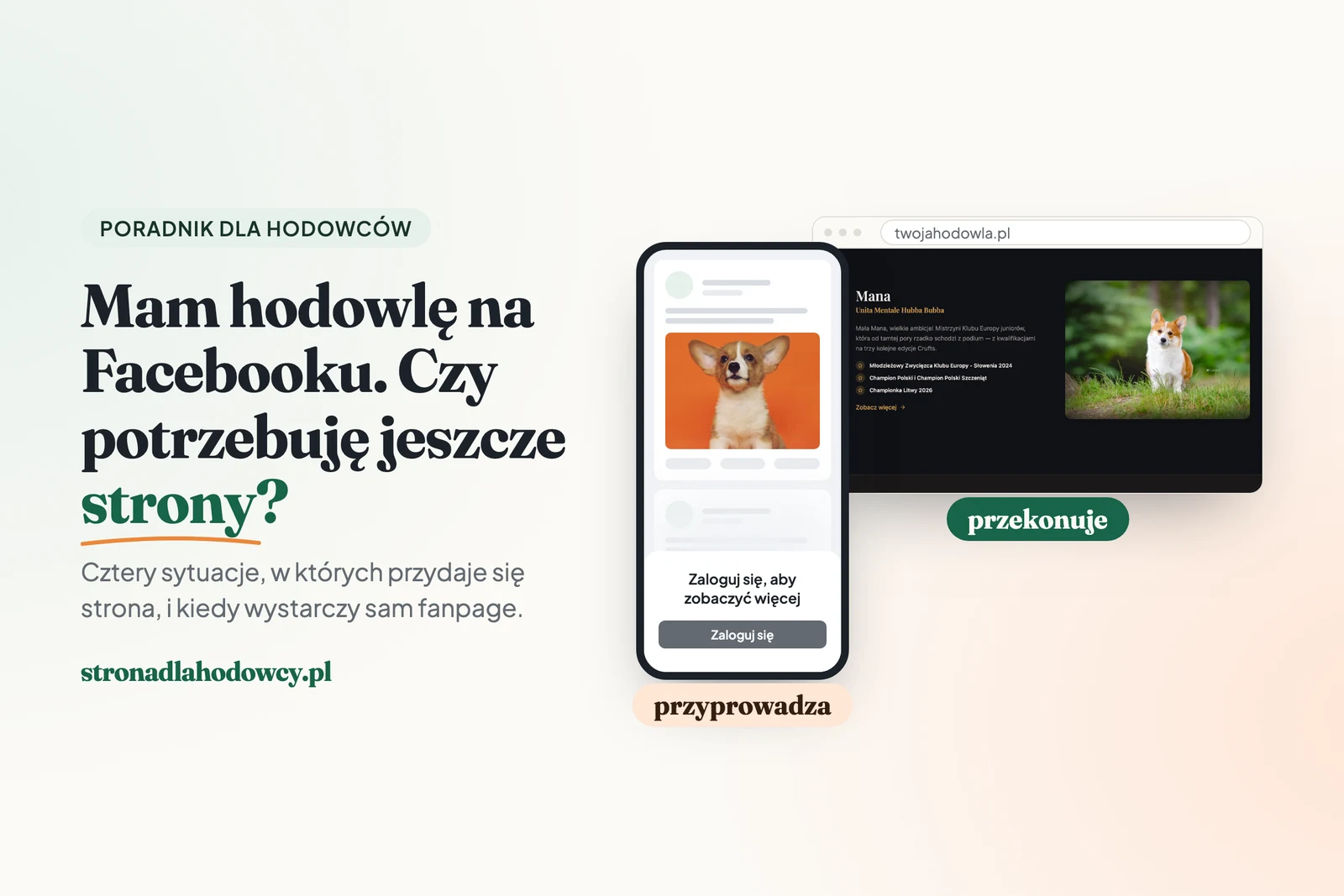
The short answer: if you have a litter every few years and buyers reach you through people you know, a Facebook page is enough. If you want a stranger from the other end of Poland, or from Germany, to find your kennel, look at the parents and their pedigrees, and trust you before they even write, you need both. Facebook brings people in. A website makes them stay and get in touch.
I am writing this from both sides at once. Kasia and I run Numenor Valar, a Pembroke Welsh Corgi kennel in Gdańsk, and I have been building web applications for a living for twelve years. We have a Facebook page and a kennel website, and each does a different job for us.
What Facebook does brilliantly
A Facebook page is the best tool there is for three things:
Reach. Shares, breed groups, friends of friends.
Community. Comments, photos from new owners, reports from shows.
Speed. A photo from your phone is online within a minute.
The trouble starts when Facebook is asked to do everything.
Four situations where a website earns its place
1. Someone types your kennel’s name into Google
They heard about you at a show or from a vet. Your Facebook page sometimes turns up in the results, but Google sees little of it, and anyone without a Facebook account gets a login window after a moment of scrolling. The top result is then often an old forum post or a kennel directory with an out-of-date phone number.
2. A buyer wants to see the parents and their pedigrees
On Facebook, a pedigree is a photo of a document in a post from two years ago. On a website, every animal has a page of its own: photos, titles, health test results and a three-generation pedigree. That is exactly what a serious buyer checks, and it is good that they do.
3. Someone asks about earlier litters
“What were your earlier litters like?” comes up in almost every conversation. On a Facebook page, last spring’s litter is several hundred posts down. A website has an archive: every litter with its parents, puppies and photos, one click from the home page. It is the best evidence of experience you have, and it deserves a permanent place.
4. The account is blocked or taken over
In breeders’ groups the story comes round every few months: someone takes over a profile, or an automated check decides a post about a litter breaks the rules, and the appeal drags on for weeks. If the whole kennel lives on Facebook, for that time it vanishes from the internet. A website on a domain registered to you keeps running.
A website is a place that belongs to you
The domain is yours. An address like yourkennel.com is easy to give out at a show, print on a business card and spell over the phone.
Content stays put. A litter’s page is at the same address next week and next year.
Everything has its place. Animals, litters, pedigrees and galleries are where a buyer looks for them.
It builds trust. Someone spending several thousand złoty on a puppy or a kitten sees, in a well-kept website, a breeder who takes the whole thing seriously.
Google, and ChatGPT and Gemini too
More and more people now ask an AI assistant: “Can you recommend a corgi kennel in Pomerania?” Assistants build their answers from pages they can read. A website describing the kennel, its animals and its litters is readable to them, while content behind a Facebook login largely never reaches them.
How to combine the two
What works best is splitting the roles: Facebook brings people in, the website convinces them.
You announce a litter on Facebook, and the link leads to the litter’s page with the parents, pedigrees and photos of the puppies.
A link to your website pasted into Facebook or Messenger shows up with a title, a description and a picture, like a proper post.
The link in your Instagram bio leads to one place where everything is.
If you pay for an ad, you point it at a page that will still be current a month from now.
When a Facebook page is all you need
If you have a litter every few years, your waiting list fills up through people you know and you want to keep it that way, a Facebook page will serve you well. A website makes sense when you want people you have not met yet to find you.
How I do it
I build websites for dog, cat and horse breeders on the same system the Numenor Valar website runs on. If you are not sure whether it makes sense in your case, write to me. I will answer myself, including when I think your Facebook page is enough.