Type your kennel’s name into Google. What does a buyer see?
Four tests, five minutes: Google, ChatGPT, a link in Messenger and your previous litters. You see your kennel through the eyes of someone who has never heard of it, and you know what to fix first.
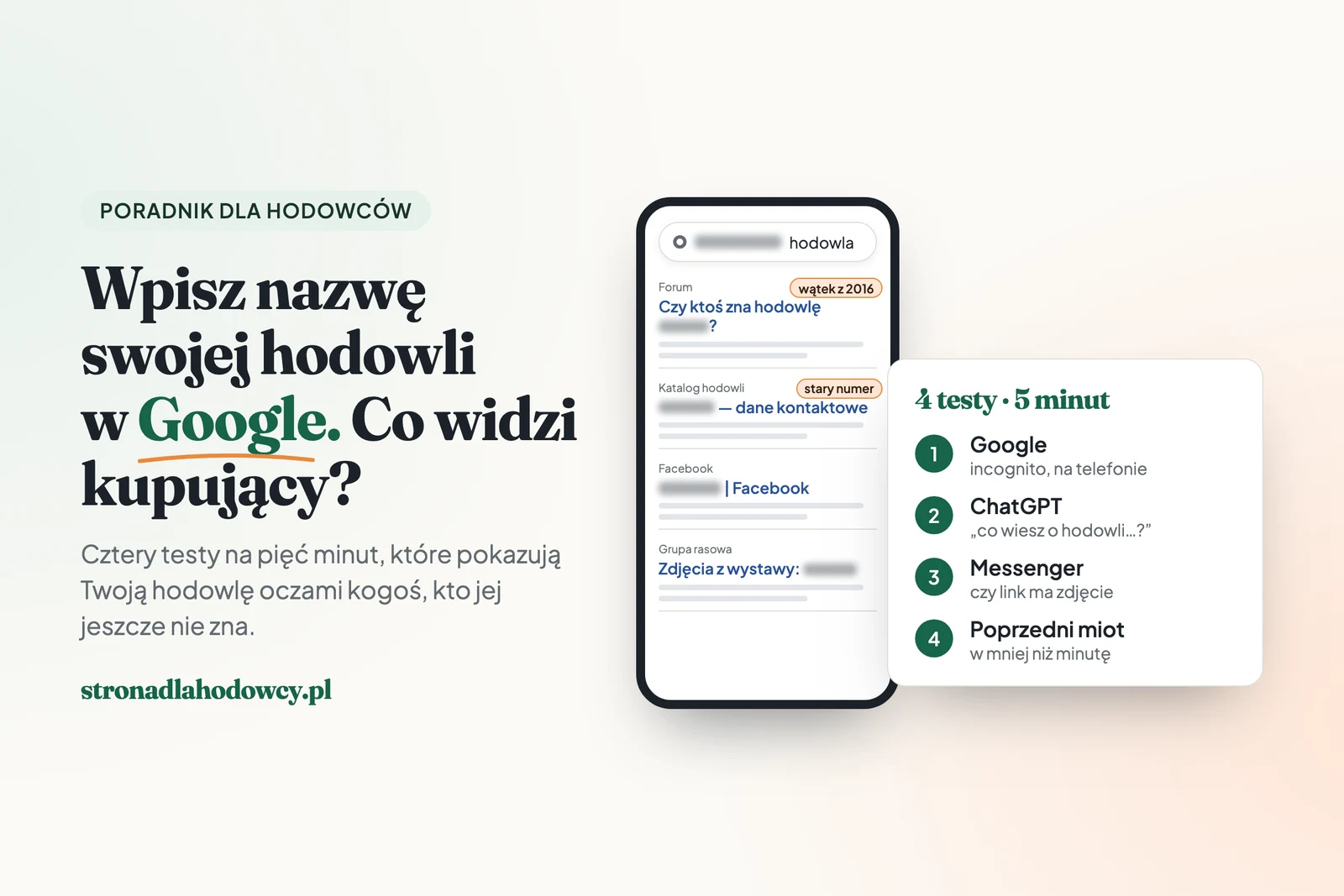
Before anyone writes to you, they almost always check you out first. They heard your kennel name at a show, got it from a friend or spotted it in a breed group, so they type it into their phone and look at whatever comes up. You know your kennel from the inside: from your logged-in account, your bookmarks, your memory. You only see their view when you set out to look at it.
Below are four tests that let you do that. Together they take about five minutes, and all you need is a phone. Write down the results; they will come in handy at the end.
Test 1: your kennel name in Google, on a phone, in incognito mode
Open an incognito, or private, window on your phone. Google shows results there without suggestions based on your history, so you see roughly what a newcomer sees. Type in your kennel name on its own, then the kennel name with the word “kennel” and the breed.
Check:
what the first result is and whether it leads to you,
whether the phone number and town in the results are up to date,
whether a listing with a map appears next to the results,
whether the first page has old forum posts, kennel directories or adverts from years ago.
A common result: your Facebook page is somewhere on the list, and above it sits a directory with an old number or a forum thread. A buyer clicks whatever comes first.
Test 2: the same question in ChatGPT or Gemini
More and more people start their search by talking to an AI assistant. Ask it two questions: “What do you know about the [kennel name] kennel?” and “Can you recommend a [breed] kennel in [region]?”
An assistant answers from the pages it has been able to read. If all it has about your kennel is generalities, if it confuses it with another or gives out-of-date details, there is too little text about it online that it can reach. Facebook posts reach it only to a small degree, because most of them sit behind a login.
Test 3: a link pasted into Messenger
Take the address you give people: your website, your Facebook page or a particular litter. Paste it into a Messenger chat with someone close to you and wait a moment before sending.
A good link unfolds into a card: a photo, a title and a one-sentence description. It looks the same on Facebook, in WhatsApp and in text messages. If you see a bare address, a logo from years ago or a random scrap of text instead, that is what everyone sees when someone recommends your kennel to them.
Test 4: your previous litter in under a minute
Start a stopwatch. Beginning with the first Google result, get to your previous litter: the parents, photos of the young, the date of birth. Ideally, ask a family member who does not know where to look.
Almost every serious buyer asks about previous litters, because they are the simplest proof that a kennel has been going for years and knows what it is doing. Every minute spent scrolling through posts is a minute in which they may go back to the search results, where the next kennel is waiting.
What you can fix yourself, today
A Google Business Profile. A free listing with a map, phone number and photos that shows up next to the results. Choose a breeder category, such as “Dog breeder”, and add a link to your Facebook page or website. If visitors come to you by appointment only, you can hide the address and show just the area you serve.
A complete Facebook page. In the “About” section: kennel name, breed, town, club (ZKwP, FIFe, WCF and others), phone, email. Plus a pinned post with the current litter or an announcement.
An album for each litter. With the date and the parents’ names in the title. Previous litters are then two clicks from your Facebook page.
Old listings. A kennel directory or a club website with your old number: write to the administrator and ask for a correction. One email is usually enough.
When that is not enough
These fixes help with tests 1 and 3. Tests 2 and 4 need something more: a place where the kennel is described in full sentences and every animal and every litter has an address of its own. Google and AI assistants can both read a page like that, and a buyer finds the previous litter with one click from the menu.
If in the first test another kennel or an old directory ranked above you, and in the fourth you were still looking at a feed after a minute, it is a sign your kennel needs a website of its own.
If the result surprised you
Kasia and I run Numenor Valar, a Pembroke Welsh Corgi kennel in Gdańsk, and I build web applications for a living. If one of the tests showed you something unexpected, write to me with your kennel name. I will run the four tests myself and reply with what I would fix first, including when changes to your Facebook page are enough.